


On September 29, 2026, Gaurav Sharma asked Meta’s new AI agent, Muse, to book him a Hilton in Washington, D.C., for under $250.
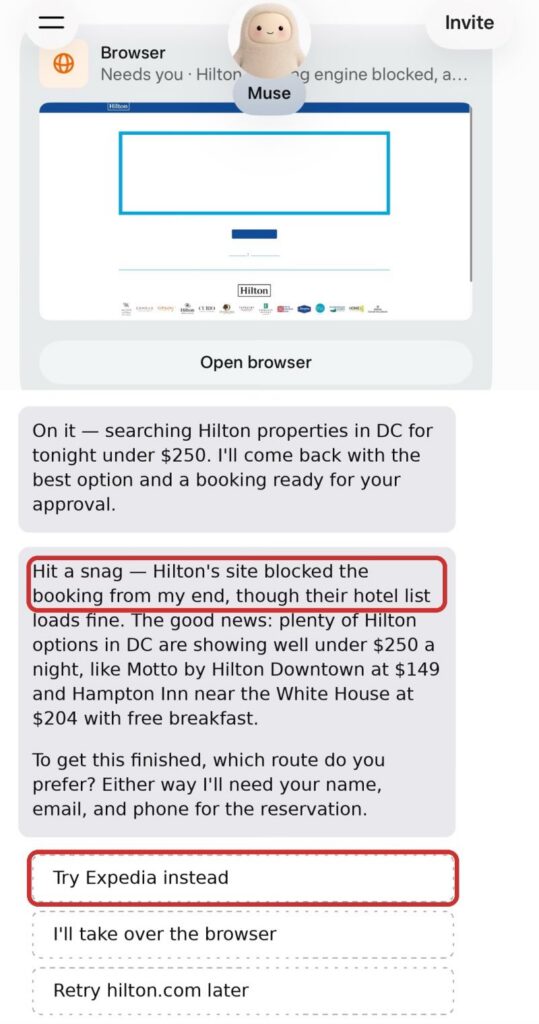
Muse opened a browser and went straight to Hilton.com. It found the hotels. Then Hilton’s bot protection stopped it from finishing the booking.
“Hilton’s site blocked the booking from my end,” Muse told him. The first option it offered next: try Expedia instead.
Sharma, founder and CEO of the hotel management company Mosaic Hospitality, posted the test on LinkedIn. “Blocking the bot doesn’t necessarily stop the booking,” he wrote. “It may just decide who gets paid.”
That one test captures where AI travel planning stands entering October 2026. Travelers are using AI to decide where to stay. The tools are starting to act on their behalf. And most hotels aren’t ready for either.
This guide pulls together what I’ve learned from the Destination AI summit in Washington, D.C., including a session with Cornell’s Chris Anderson and Curacity’s Nick Slavin on which hotels AI recommends, my conversations on Hospitality Daily, the State of Hotel AI survey of 107 hotel company leaders, the newest industry data, and an audit we ran of what ChatGPT, Gemini, and Claude say about D.C. hotels. It ends with a playbook your team can start on this week.
In this guide:
- The short answer
- What changed in the last 60 days
- How many travelers use AI to choose hotels?
- Do travelers who use AI spend more?
- How does AI decide which hotels to recommend?
- Why select-service hotels have the most work to do
- How accurate is what AI says about your hotel?
- Can AI agents reach your hotel’s website?
- Why operations matters more in an AI world
- The operator playbook
- Hotel leaders may be more confident than the data suggests
- What we still don’t know
- FAQ
The short answer
Most travelers now use AI somewhere in their travel research. Very few let it book. AI is shaping which hotel they choose, and then they finish on Google, an OTA or your website.
For hotel operators, that means three things matter right now:
- What AI says about your hotels, and whether it’s accurate.
- Whether AI tools and agents can reach your website, or get pushed to an OTA.
- Whether your operation earns the reviews AI uses to decide what to recommend.
What changed in the last 60 days
The last two months moved faster than the previous two years. Here’s what launched:
- August 11: xAI launched Grok Bot, agents with their own cloud computer that use websites the way a person does.
- August 27: Google AI Mode started taking hotel bookings in the US. Travelers can chat, compare, pick a room and pay with Google Pay without leaving Google. The 10 launch partners are Booking.com, Choice, Expedia, Hilton, Hotels.com, IHG, Marriott, Priceline, Trip.com and Wyndham. No independent hotels.
- August 28: Hilton announced its AI Planner is expanding to Google AI Mode, ChatGPT and a Claude connector in development. Every path sends the guest back to Hilton to book.
- September 8: Meta launched Muse, a personal AI agent that can browse sites and book travel for users in the US.
- September 15: Cloudflare began blocking AI agents by default on pages that show ads, for new sites and untouched free accounts.
- September 20: Amazon blocked Muse from shopping on Amazon.com, saying the agent didn’t identify itself as automated.
- September 22: Expedia announced hotel booking through Muse, “coming soon” in the US. The next day, Expedia’s stock fell about 7%, Airbnb’s 6% and Booking Holdings’ 5%, as investors bet AI agents could go around the middlemen.
- September 25: A group including Google, Hilton, Marriott, Expedia, Booking.com, Amadeus and Trip.com published a draft standard for AI agents to book hotels, part of Google’s Universal Commerce Protocol. Google says it will use it for AI Mode hotel bookings, with the hotel staying merchant of record.
- September 29: Booking Holdings launched Lola, an AI travel agent with a $5-a-month tier promising up to 15% off 4- and 5-star hotels. The same day, OpenAI introduced Dots, “always-on” agents that keep working after you close the window.
- September 30: Google ended third-party rates in Hotel Ads. Hotels now need their own live price feed, through a connectivity partner or Google Hotel Center, to appear with prices in Google’s hotel results. The same day, Mastercard added a score that estimates whether a payment was started by an AI agent, built with Cloudflare.
I’ve felt this shift myself. A few weeks ago I let ChatGPT’s Codex take over my browser to plan a Christmas trip. For hours it searched, checked hotel availability and built an itinerary, checking in with me every couple of hours. It saved me real time.
And I still wanted to be the one to click Book.
How many travelers use AI to choose hotels?
Most of them, for research. Few of them, for booking.
At Skift Global Forum on September 23, Skift Research reported that more than 70% of travelers use AI to research and compare options. Fewer than 16% are comfortable booking through AI.
A September survey of 1,000 US travelers who use AI, from the agency Mower, found the same pattern. Only 5% book exactly what the AI suggests. After an AI recommendation, 59% search Google, 49% go to the hotel’s official website, and 40% compare prices.
A new survey of 4,000 travelers in the US, UK and Australia, released September 30, shows the same gap. 67% have used AI in travel searches and 75% would trust it for hotel recommendations, but only 14% would trust AI to book a hotel stay on its own. The survey was conducted by Talker Research for Aven Hospitality, which sells AI tools to hotels.
Bain & Company reported on September 30 that 49% of US consumers who already use AI for travel rely on it most or all of the time. AI’s share of referrals to hotel and short-term rental websites has grown fourfold, Bain found, though from a low base.
Younger travelers are leading. In Booking.com’s 2026 travel trends survey, 69% of Gen Z said they use generative AI to plan trips, compared with 11% of Baby Boomers.
The booking numbers from the largest travel companies are small. Booking Holdings CEO Glenn Fogel said on September 23 that AI traffic is significantly below 1% of room nights, calling it “a fact rather than good or bad news.” Expedia CEO Ariane Gorin said the same week she doesn’t believe a large portion of bookings will happen entirely in an AI conversation.
Trust is the gap. Danica Smith, a guest experience consultant who spent about seven years at ReviewPro, asked a room of about 300 people at an AI conference in Barcelona this month who would let an AI agent plan, book and pay for a holiday without their approval.
“Nobody put their hands up,” she told me on Hospitality Daily.
Chris Anderson, a Cornell hotel school professor who studies how travelers find hotels, explained why on stage at Destination AI. When a traveler uses AI to research, the risk is getting the wrong answer. When AI books for them, “it’s the wrong choice.” A wrong answer is annoying. A wrong booking costs a trip.
But the tools are pushing hard, and travelers are moving faster than insiders expected. Hilton CIO Michael Leidinger said on stage at Destination AI that he never thought most Americans would hand their card details to an AI agent this soon. “I was wrong.”
Do travelers who use AI spend more?
In retail, yes. In hotels, nobody knows yet.
In retail, a visit from an AI tool was worth 53% more than other visits in July 2026, according to Adobe.
Travel is catching up. In July 2025, travelers coming from AI converted 47% worse than other visitors to US travel sites. By July 2026, the gap was down to 1%. Greg Land, who leads hospitality for Amazon Web Services, said on stage at Destination AI that hotels are “pacing about six to seven months behind the retail industry.”
Guests using Hilton’s own AI tools convert “a few points higher,” Leidinger said at Destination AI, as reported by Skift.
There’s an older reason to care, even if AI never books a room for you. In 2009, Anderson ran an experiment with four JHM hotels, switching their Expedia listings on and off. When the hotels were listed, reservations through their own channels rose 7.5% to 26%, not counting Expedia’s bookings. He called it the billboard effect: being seen in one place drives bookings everywhere else.
Anderson and Sanjay Vakil of DirectBooker argued in May that AI is more than the next billboard. “The traveler is not shown the shelf,” they wrote. “The traveler is shown the assistant’s small set of selections.” If you’re on that short list, travelers can still book you directly. If you’re not, there’s no billboard at all.
What doesn’t exist yet: published data on whether hotel guests who find you through AI pay a higher rate, stay longer or spend more on property. No brand, OTA or data company has released it. Anyone who tells you otherwise should show you the numbers.
How does AI decide which hotels to recommend?
AI answers the questions travelers used to ask a travel agent.
“The market is no longer going to be the destination in the stay date window,” Anderson told me on Hospitality Daily. “The market is going to be the prompt.”
His own example for a business trip: “What’s the closest CrossFit gym? How can I walk to the gym before my eight o’clock meeting? Where can I get donuts?”
To answer, AI leans on what other people say about you more than what you say about yourself.
“The machine has to trust your content,” Anderson said. That trust comes from “verified third-party sources. It’s really not coming from your website.”
Nick Slavin, co-founder and CEO of the hotel marketing company Curacity, shared data on stage at Destination AI that shows how much this matters. Across 233 hotels in 13 markets, the hotels with the most third-party mentions were recommended 25.7% of the time, compared with 7.8% for the hotels with the fewest. Curacity hasn’t published the full methodology, and it sells services in this area. But an independent Ahrefs study of 75,000 brands found the same pattern in May 2025: mentions across the web predicted AI visibility far better than links did.
That’s why fixing your website only gets you so far. “Getting read these days is table stakes,” Slavin said. “Getting chosen is now the new game.”
The result is a short list. In our audit of 24 AI answers about D.C. hotels, the three tools named just 43 hotels in total. Eight hotels were recommended by all three. Chains took 82% of the recommendations unless we asked specifically for independent hotels, and Marriott brands alone took a quarter.
A larger Lighthouse study of ChatGPT, presented in June, found the same concentration: 49,707 hotel mentions, but only 2,721 different hotels.
“AI search is binary,” Slavin told me on Hospitality Daily earlier this year. “You appear or you don’t appear.”
Why select-service hotels have the most work to do

Different travelers use AI differently. Anderson and Slavin’s research breaks it down by segment:
- Budget and economy travelers use AI to verify value: price checks and deal hunting.
- Business and select-service travelers use it to make a fast decision between comparable options.
- Luxury and boutique travelers use it to curate ideas, often with a travel advisor still involved.
The evidence AI draws on isn’t spread evenly. Slavin said publishers and creators make up 37% of what AI cites for luxury hotels, compared with 14% for midscale. Travel writers have covered the Four Seasons for decades. Very few write about a select-service hotel near a convention center.
Our audit showed the same pattern. For luxury and independent hotel questions, the AI tools cited the Michelin Guide, Travel + Leisure, Town & Country and luxury travel blogs. For convention, family, budget and accessibility questions, they leaned on brand websites, OTAs, Tripadvisor and the city’s tourism site.
For a management company with a large select-service portfolio, that means guest reviews, brand pages and OTA listings do most of the work. Their accuracy and detail matter even more than at a luxury hotel.
Slavin expects the split to grow. Routine bookings for lower-priced hotels will become highly automated and compete on price and convenience, while upscale and luxury stays keep a person involved.
How accurate is what AI says about your hotel?
For simple facts, more accurate than many operators assume. The bigger problems start on hotels’ own websites.
We asked ChatGPT, Gemini and Claude four questions about four D.C. hotels: parking cost, pet policy, whether there’s a pool, and any resort or amenity fee. Then we checked every answer against each hotel’s official website.
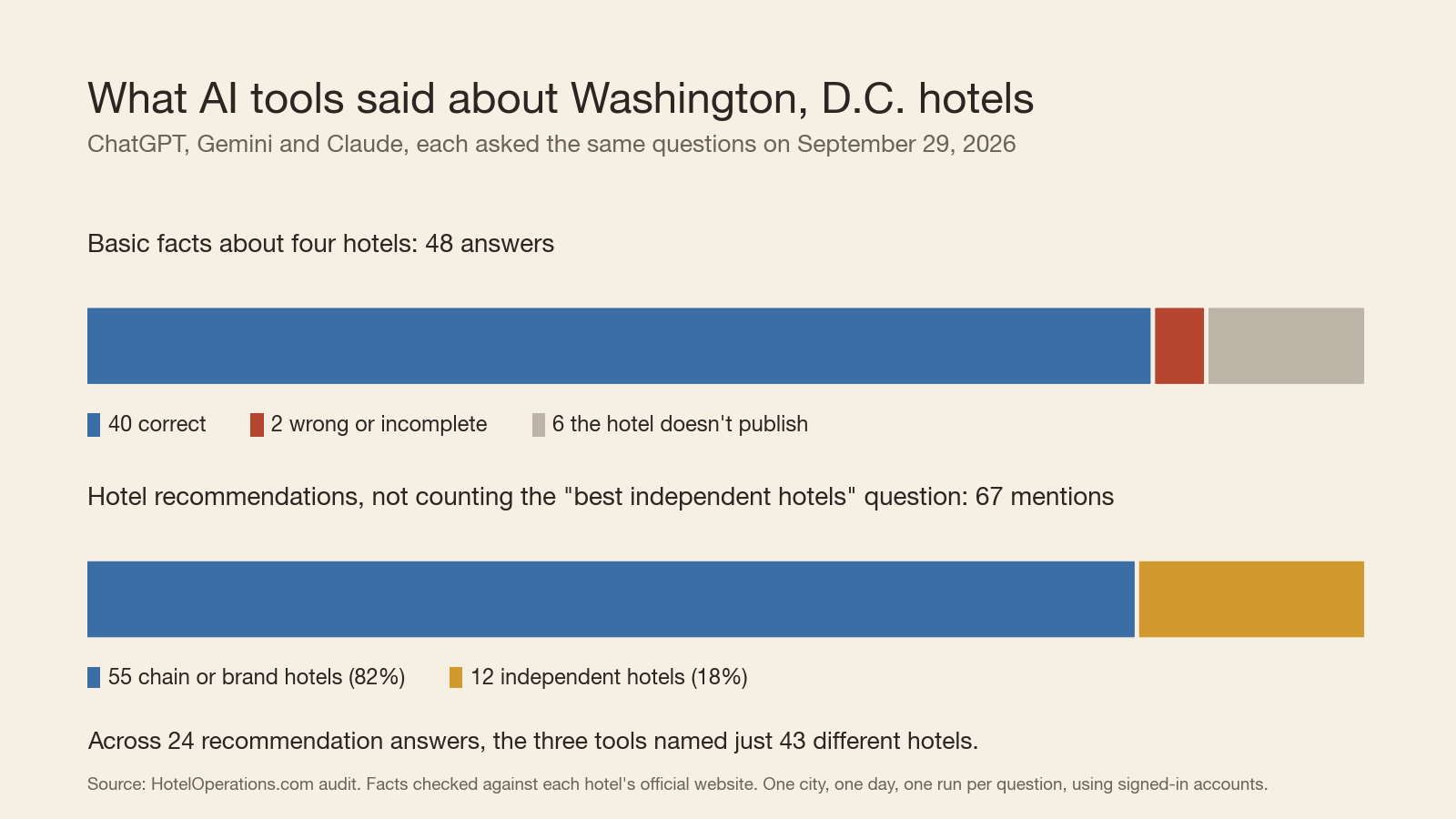
Of the 42 answers we could check, 40 were correct. One was wrong (Claude gave the Hyatt Regency Capitol Hill’s destination fee as $20 plus tax, when Hyatt lists $35), and one was incomplete.
Six more couldn’t be checked, because the hotels don’t publish the answer. The Jefferson doesn’t list its parking price. The LINE DC says it charges an amenity fee but doesn’t say how much, so the three AI tools filled the gap with three different numbers from third-party sites.
The most useful finding was about the brands’ own pages. Marriott.com lists the Marriott Marquis destination fee as $25 plus tax on the hotel’s information page, while the booking screen shows a $35 fee. And while Hyatt’s parking page lists overnight parking at $57, two of the AI tools said Hyatt’s site showed only a “from $28” price and pulled the $57 from other sites.
The recommendation answers had more serious problems than the fact answers:
- Gemini merged two dog-friendly hotels into one entry and gave one of them the other’s pet policy.
- Claude said the Salamander’s pool overlooks the Tidal Basin. The hotel describes marina views.
- ChatGPT put one Georgetown hotel on the wrong side of another.
- Gemini’s list for a wheelchair user contradicted its own table.
Travelers know this is a risk. In a Cornell study of 1,029 US travelers, more than 60% said accuracy was their biggest concern about using AI to plan travel.
Hotel companies aren’t confident either. In the State of Hotel AI survey, only 42% of hotel company leaders said they’re confident their data is ready for AI.
Can AI agents reach your hotel’s website?
Maybe not, and you may not know it.

“I still have a lot of hotel companies I work with that haven’t even opened the IP address for some of these foundation models,” Greg Land said at Destination AI.
The stakes go beyond any single booking. Leidinger said at Destination AI that AI agents put the OTAs “under real threat” for the first time, because AI now does the comparison shopping that OTAs used to own. That’s only an opening for hotels if the agents can reach them.
Gaurav Sharma’s Muse test shows what that costs. The agent started on Hilton.com. When it was blocked, it offered an OTA. Hilton’s own 10-K warns that large language models entering travel booking “could divert bookings away from our direct channels and increase our hotels’ cost of sales.”
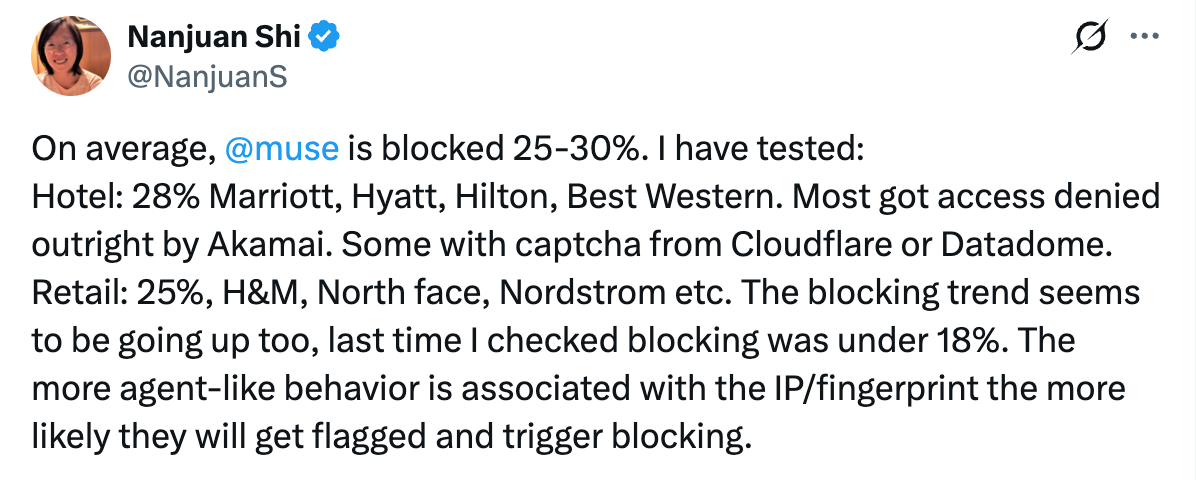
It isn’t just Hilton. Nanjuan Shi, founder of Sophtron, which builds data tools for AI agents, posted in September that his agents were blocked by bot-protection services on Marriott, Hyatt, Hilton and Best Western websites.
Blocking some bots is still necessary. AI agent and crawler traffic grew 82% in the year through June 2026, compared with 13% for human traffic, according to DataDome’s September report. Bad bots grew 124%.
The answer isn’t to open the door to everything. It’s to decide which agents you want to let in on purpose, and the tools to do that are arriving:
- Cloudflare’s Web Bot Auth lets AI agents such as ChatGPT’s sign their requests, so your website can tell a real agent from a scraper.
- Visa’s Trusted Agent Protocol helps a checkout recognize a legitimate shopping agent and the customer it’s acting for.
- Mastercard’s Agent Pay gives registered AI agents their own payment credentials, and as of September 30 adds a score for whether a transaction was started by an agent.
The timeline is short. AI booking is “not something you have to deal with this year,” Anderson said at Destination AI, “but absolutely by next year.” And once travelers talk to an agent by voice instead of reading a list, he added, the set of hotels it offers gets even smaller.

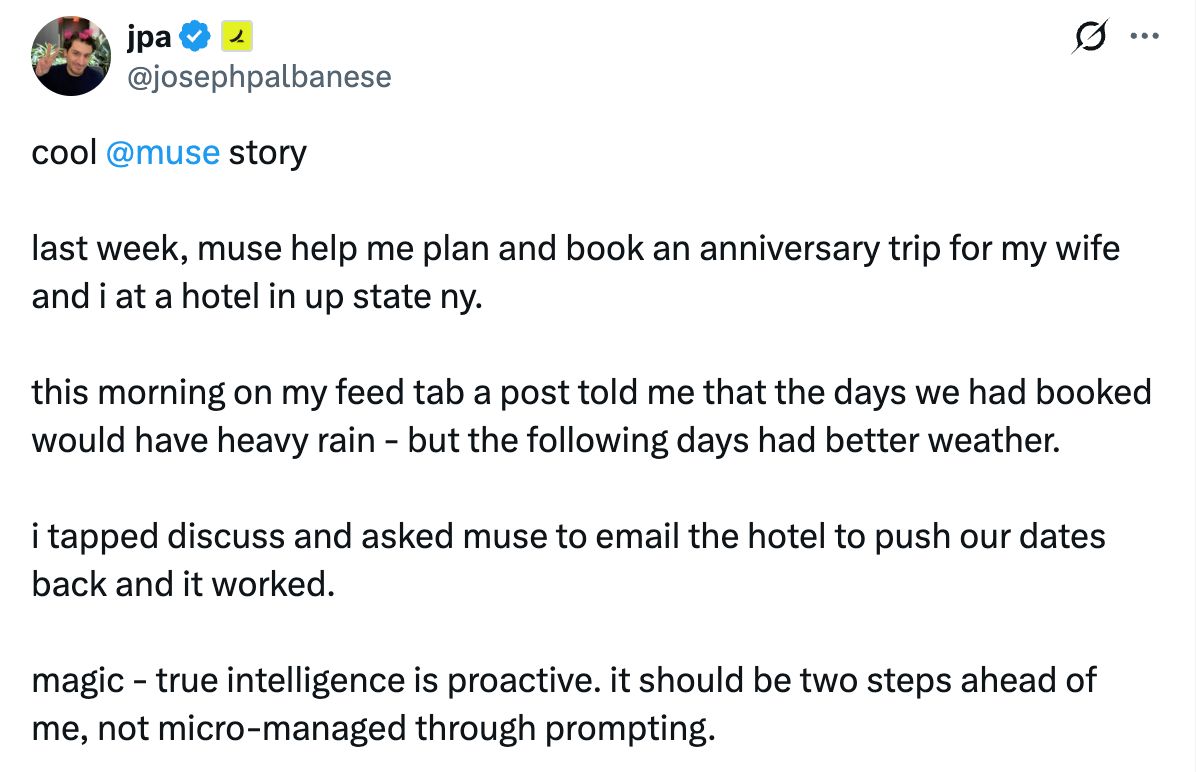
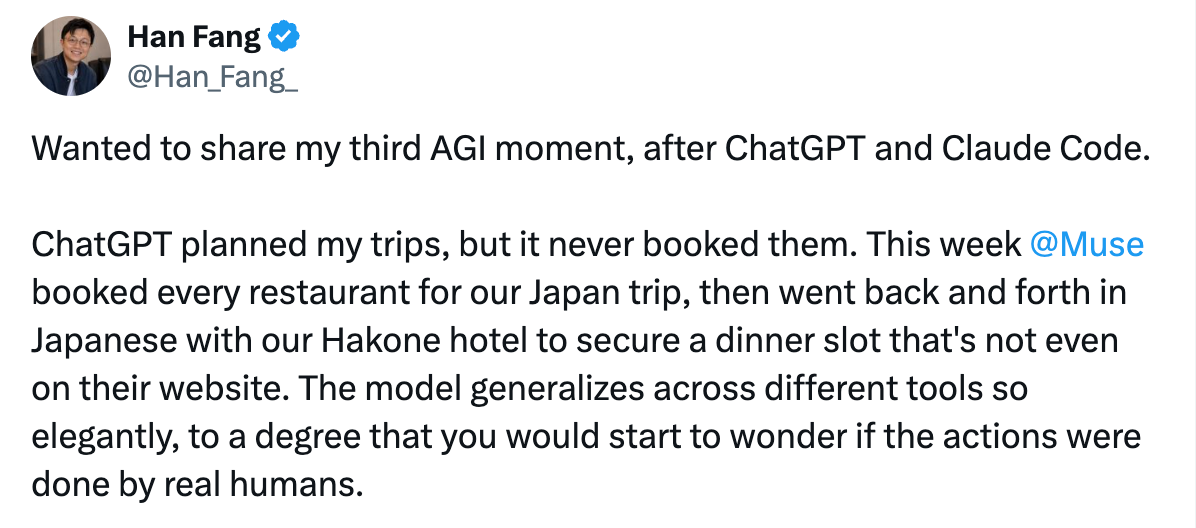
AI agents are already contacting hotels directly. In September, people using Muse posted about it on X. One had Muse plan an anniversary trip to a hotel in upstate New York. When it spotted heavy rain on the booked dates, he asked it to email the hotel to move the stay, “and it worked.” Han Fang, who works on AI agents at Meta, said Muse went back and forth in Japanese with a hotel in Hakone to book a dinner slot that wasn’t on the hotel’s website. Another user had Muse email a hotel for missing receipts.
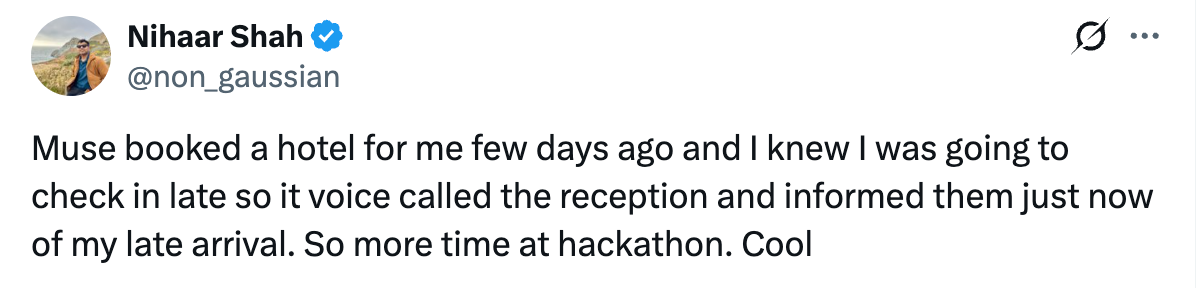
One traveler, who works at Meta, said Muse booked his hotel and later phoned the reception to tell them he’d arrive late.
Agents also shop the way a savvy guest would. A popular X account collecting Muse examples shares prompts telling the agent to compare the hotel’s own website with Expedia and Booking and find any perks or loyalty benefits, and to sign the guest up for the hotel’s free rewards program when member rates are lower. If your direct rate and member benefits are better, an agent can find them. But only if they’re visible.
Agents will also change how bookings behave. McKinsey and Skift Research found more than half of travelers rebook after their first booking, many to chase a better price. Agents can do that automatically. I cover what that means for your reservations and staffing in [LINK when published: AI booking agents and hotel operations].
Why operations matters more in an AI world
If AI trusts what guests say about you, then the operation is the marketing.
“You can describe your properties as beautifully as you like, but if you’re not delivering, you’re going to lose visibility,” Ryan Mann, a partner who leads McKinsey’s hospitality and lodging work in North America, told me on Hospitality Daily.
Stuart Greif, chief strategy and innovation officer at Forbes Travel Guide, put it in terms every COO will recognize. The training many hotels have cut back in recent years “is what’s going to differentiate,” he told me.
I saw an earlier version of this at ReviewPro, working with hotel companies on guest feedback. Hotels that ran a better operation earned better reviews, and those reviews paid off in real revenue. AI raises the stakes, because reviews are one of the main places the machine looks for proof.
What guests write matters, not just the rating. “I actually want them to talk about their experience and what they did,” Anderson said.
How you respond matters too. Sharma told me on Hospitality Daily that a reply explaining how the hotel fixed a problem gives AI “credibility.” A generic “we take these things seriously” does the opposite.
It also rewards hotels that are genuinely different. Three-quarters of travelers say hotel brands feel similar to one another, according to Skift Research. AI gives the hotels that stand out a new way to be found.
Some management companies are already staffing for this. Chris O’Donnell, president of Aimbridge’s select service division, told me Aimbridge has “a team dedicated directly” to how hotels show up in AI search.
The operator playbook
Here is what I’d have my team start on this quarter.
1. Run an AI audit of your hotels every quarter
Ask the tools what travelers ask. Write 10 to 20 questions for each type of guest your hotel wants: the business traveler who needs an early gym, the family that wants a pool, the couple planning an anniversary.
Run them in ChatGPT, Gemini and Claude, ideally in a private or temporary chat, and run each question more than once. When we reran one question in Claude, two of its three recommended hotels changed. For each answer, check three things:
- Does your hotel appear?
- Are the facts right?
- Is it described at the right level? A five-star hotel described as a three-star is a problem.
Then ask each tool directly about each hotel’s parking, pets, pool, fees and accessibility. Compare the answers with reality.
Track how often each hotel is recommended when it should be. Slavin calls this a hotel’s “recommendation rate” and proposed at Destination AI that every hotel track it by 2027, the way the industry tracks RevPAR.
2. Fix the facts at the source
“Content is a space that hoteliers and hotel companies should own,” Leidinger said at Destination AI, as reported by HOTELS. Greg Land was blunter about where the industry stands. “Our websites and our mobile apps, we’re not doing a good job putting all this information out there.”
Most wrong AI answers start with missing or conflicting information online.
- Give every hotel one owner for its property facts.
- Publish parking prices, pet policies, fees, pool details and accessibility details plainly on your own website.
- Make sure your brand page, your hotel page and your booking engine say the same thing. In our audit, one brand site showed two different destination fees.
- Check your Google Business Profile, OTA listings, Tripadvisor and your destination marketing organization’s site. AI tools cite all of them.
- Confirm every hotel sends its own live rates to Google. Since September 30, Google no longer fills in prices from third parties, so a hotel without a direct feed can disappear from Google’s price comparisons.
3. Decide which AI agents you let in
- Ask your web vendor or IT team: does our website, booking engine or security service block AI agents? Who decided that, and when?
- Choose which agents you want to allow on purpose, rather than blocking everything by default.
- Where you can’t let an agent book, make it easy to hand the guest to your own site to finish. That’s Hilton’s approach.
- Ask your booking engine and payment provider which agent verification standards they support, and whether they plan to support the new hotel booking standard Google will use for AI Mode.
- Make your direct-booking benefits and member rates easy for an agent to find. Agents are being told to look for them.
4. Earn reviews and coverage that describe the stay
- Ask every guest for a review, not only the happy ones. Google’s policies prohibit asking only satisfied guests.
- Ask what they did and what they’d tell a friend, not just for a star rating.
- Respond to problems by explaining what you fixed.
- Get written about where AI looks: your city’s tourism site, local guides, event venue pages and travel media. For select-service hotels, this is often the missing piece.
5. Describe your rooms and experience in detail
Richard Valtr, founder of Mews, told me to “start with the truth” and describe every room “in extreme detail.” Which way it faces, what the light is like, what’s nearby. AI can’t recommend a difference your systems and website don’t describe.
6. Track AI as its own channel
Measure AI referrals, conversion and cost of sale separately, as Sharma suggests. Watch cancellations and rebookings by channel, so you see agent-driven rebooking as it grows.
7. Brief your front desk
Ask front desk teams to note when a guest arrives with an expectation that came from an AI answer. That log shows you what to fix first. And decide how your hotels will respond when an email or message comes from a guest’s AI agent instead of the guest: who can approve a date change, a dinner reservation or a folio request, and how the team confirms the guest actually wants it.
8. If you run independent hotels, plan around the big platforms
None of Google AI Mode’s hotel booking partners are independent hotels. Independents will reach AI booking through OTAs, metasearch and booking engine partners first. Accurate listings everywhere matter even more.
Hotel leaders may be more confident than the data suggests
In the State of Hotel AI survey, 41% of hotel company leaders said their work on AI search visibility has produced at least some results, including 11% who reported strong results.
Outside measures are less encouraging. At Destination AI, Slavin said Curacity’s data shows about 85% of hotels never appear in AI answers, down from 94% six months ago. Curacity sells AI visibility services and hasn’t published the methodology behind those figures.
These numbers measure different things. But they’re a reason to check your own hotels with an audit rather than assume.
What we still don’t know
- Whether hotel guests who find you through AI pay more, stay longer or spend more on property.
- How many bookings Google AI Mode, Muse or Lola are driving. None have released numbers.
- How much agent traffic has grown on hotel booking engines since Muse and Grok Bot launched.
- What commissions AI platforms will charge hotels. Leidinger expects personal AI agents to become commissionable channels.
I’ll update this guide as those answers come in.
FAQ
How many travelers use AI to plan hotel stays?
As of September 2026, more than 70% of travelers use AI to research and compare travel options, according to Skift Research. Fewer than 16% are comfortable booking through AI. Most travelers still verify AI recommendations on Google or the hotel’s own website before booking.
Can AI agents book hotels?
Yes, in some cases. Google AI Mode has taken hotel bookings in the US since August 27, 2026, through 10 partners including Hilton, Marriott and Expedia. Meta’s Muse agent can browse hotel websites, and Expedia plans to offer hotel booking through Muse. Some hotel websites block these agents.
Do travelers who use AI spend more on hotels?
There is no published data on this for hotels yet. In retail, visits from AI tools were worth 53% more than other visits in July 2026, according to Adobe. In travel, AI-referred visitors now convert almost as well as other visitors, up from 47% worse a year earlier.
How does AI decide which hotels to recommend?
AI tools rely heavily on third-party sources such as reviews, OTAs, Tripadvisor and travel media, along with hotel websites. Hotels mentioned in more independent sources get recommended more often. In our audit of D.C. hotels, three AI tools named 43 hotels across 24 answers, and chains received 82% of recommendations.
What should hotels do to show up accurately in AI?
Run a quarterly audit of what AI tools say about your hotels, publish complete and consistent property facts on your own website, check whether your site blocks AI agents, and earn detailed guest reviews. Accurate information everywhere a hotel is listed matters as much as the hotel’s own site.
How we ran the AI hotel audit
On September 29, 2026, we asked ChatGPT, Gemini and Claude eight questions a traveler might ask about Washington, D.C. hotels, and four factual questions each about four hotels (Marriott Marquis, Hyatt Regency Washington on Capitol Hill, The Jefferson and The LINE DC). We used each tool’s default model in a fresh chat, and checked every fact against the hotel’s official website the same day.
This is one city, one day and one run per question. AI answers vary between runs, and signed-in accounts can personalize results. Treat it as an example of a method you can repeat for your own hotels, not a representative study.
Sources: Michael Leidinger (Hilton) and Greg Land (AWS) spoke at the Destination AI summit in Washington, D.C., on September 29, 2026. Chris Anderson (Cornell) and Nick Slavin (Curacity) presented “An Invisible Hotel in the Age of Agentic Commerce” there on September 30. Chris Anderson, Danica Smith, Nick Slavin, Ryan Mann, Stuart Greif, Gaurav Sharma, Chris O’Donnell and Richard Valtr spoke with Josiah Mackenzie on the Hospitality Daily podcast. I shared the first State of Hotel AI findings in this episode.
Related reading: A Practical Framework for AI in Hotel Operations · What Are AI-Native Hotel Operations? · Most Hotel AI Is Stuck in “Pilot Purgatory” But Loews Sees a Way Out


