



by Josiah Mackenzie
Founder & Publisher, HotelOperations.com
Josiah created this article based on a series of interviews with leaders from Actabl, which serves more than 180,000 hoteliers every day with its hotel operations technology.
Last year, according to data from Actabl, hotel general manager turnover was 28%, and assistant general manager turnover was even worse: 38%.
Think about what that means. More than a quarter of the GMs running hotels today weren’t in their roles a year ago. Nearly four in ten AGMs are new. And the people who left often took decades of pattern recognition, operational instinct, and institutional knowledge with them.
I’ve been hearing about talent challenges for years in my work on this site and in hosting the Hospitality Daily podcast. But recently, at conferences and in private conversations with hotel leaders, something has shifted. The question is no longer just “how do we find enough people?” It’s becoming “how do we make the people we have as effective as possible, as fast as possible?”
It’s into this context that AI enters the picture. Not as a replacement for experienced operators, but as a way to close the gap between what new team members know and what the job demands.
Actabl works with 90% of the top 50 hotel management companies, and I recently sat down with three leaders at the company to understand how they’re thinking about this from their perspective. What emerged is a practical framework that I think every hotel operator should understand.
The talent problem is structural

Andrew Arthurs is President and Chief Operating Officer at Actabl. Before that, he was Chief Information Officer at some of the largest hotel management companies in the world: Aimbridge, Interstate, and Two Roads. One of the things I appreciate about him is how he’s never lost sight of what it’s like on the front lines. While working at hotel companies as a C-suite leader, he always carved out time to work with frontline associates, and in his role today, he stays close to operators across the industry.
When I asked him what he is hearing on this topic, he told me: “We hear a lot from our property leadership teams about the challenges they have onboarding new team members. As we attempt to bring back a portion of the workforce that may have left during COVID and perhaps enrolled in the gig economy, we know we need to provide a more flexible work environment.”
Andrew also noted something that doesn’t get enough attention: the burden that technology itself can place on new team members. “We’re very mindful of the burden of technology on the property teams, especially those new team members who are joining who might be learning a brand new job, or even might be learning the industry for the first time.”
Stephen German, SVP of Product at Actabl, shared a story he heard on the Vegas Strip that underscored the challenge of training. His team was interviewing hotel staff about their tools and onboarding processes, and one group told him that several of their technology providers charge for training, and the tools weren’t very intuitive for self-service. So they organized their own monthly training sessions, in which an expert from one of the hotels in their group would train all the new people on a rotating basis.
Hotels are training each other’s staff because the learning curve is that steep. That tells you something about where the friction lives.
Why invest in associate technology?
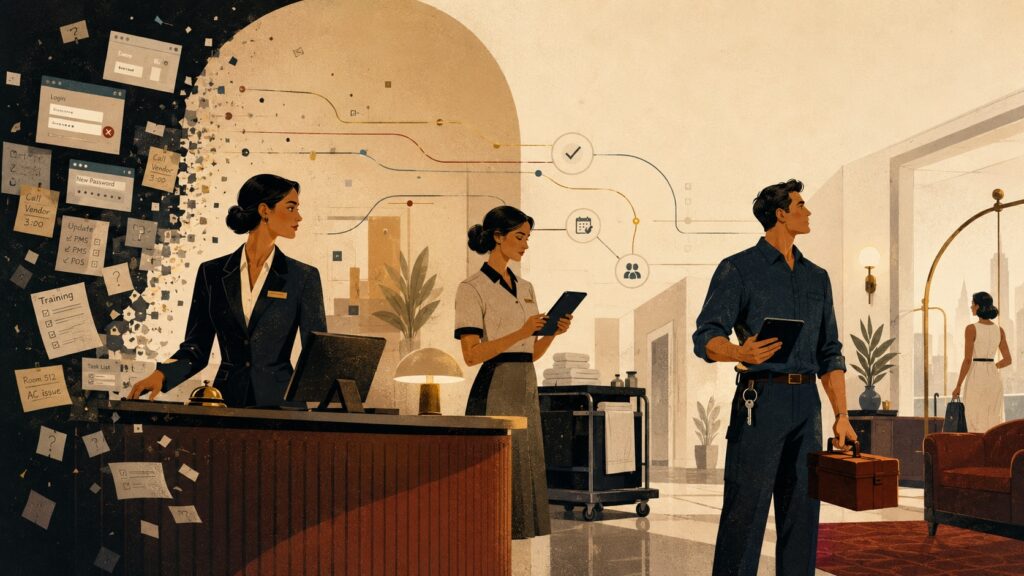
There’s a reasonable question here: why not just put all your investment in guest-facing tech? Why invest money in tools for associates?
Andrew’s answer framed a good way to think about this. “The associates on property are the ones that are serving the guests,” he said. “We really think a lot about the friction as part of the employee journey at the hotel level, and how we can reduce the amount of friction and provide everyone on property with the ability to be more productive. Being more productive looks different in different roles, but ultimately, what that translates to is a better guest experience.”
I was talking to somebody recently who told me their goal was to hire based on talent, their ability to read a room, to read their guests, to serve them really well. Their ideal state is that technology fades into the background.
That’s the right aspiration. You want to hire people who are great with people, not people who are great with software. The technology needs to meet them where they are.
AI as a coach, not a replacement

“I don’t believe that anyone wakes up in the morning and says, ‘I’m going to do a bad job today,'” Stephen told me. “But if you’re fighting with systems, then you’re not serving the guest well. And if you’re not using the systems, then you could be serving the guest better.”
So where does AI fit? “A lot of what we’ve been building is cutting to the core of it,” Stephen continued. “How do we replicate a lot of that decision tree logic that lives in the heads of experienced people? If this, then this, then check that, and just have the AI surface it up to you.”
What he’s describing with AI is essentially giving every associate a coach. “You can have an experienced person that’s been doing it for 20+ years sitting alongside you in the form of AI that’s helping to drive that and make you effective, regardless of whether you’ve used that tool before.”
Andrew was careful to add an important qualifier. “There’s no question that technology can be a superpower, can supercharge the property teams. The reality is it starts with the individuals.” He gave the example of labor management. If a manager is keeping a close eye on labor costs and understands the impact on operating margins, technology can supercharge their ability to manage effectively. But if that manager wasn’t paying attention in the first place, no amount of technology will fix it.
“It’s really this intersection of the power of technology and the leadership capabilities of the individuals on property,” he said.
That’s key. AI amplifies what’s already there. It doesn’t create something from nothing.
The three-layer framework
Stephen walked me through a framework for applying AI in hotel operations. It has three layers, and the order matters.
Layer 1: Data foundation
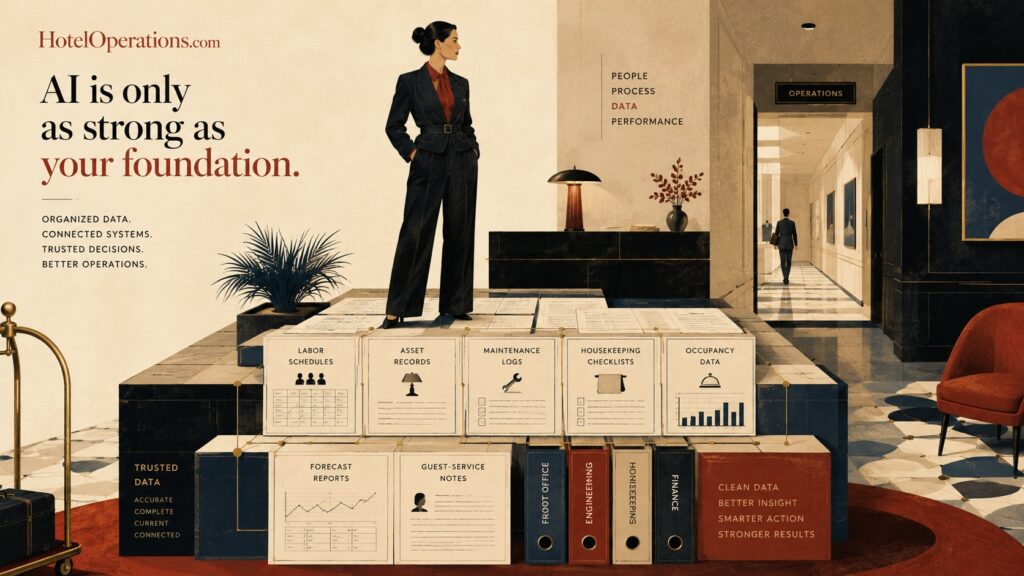
Everything starts with data, Stephen said, as anyone who has used Claude or another advanced LLM knows. “The most valuable thing is the connectors. It’s what you can bring in to Claude so that you can act on it.”
The same principle applies in hotel operations. If you’re asking questions about your business using a general AI model, you’ll get generic answers. The value comes from your data about your business.
But getting that data in order isn’t trivial. Stephen talked about one of his frustrations with tools where you can’t get the data out, where you need to run exports or keep refreshing. “It throws off the flow. It throws off the work that you’re in.”
Actabl has built more than 400 integrations across its products that pull in data, normalize it, and enable apples-to-apples comparisons. You’re not comparing disparate sources. You’re working with one source you can trust.
Without that foundation, none of what follows works.
Layer 2: Surfacing intelligence
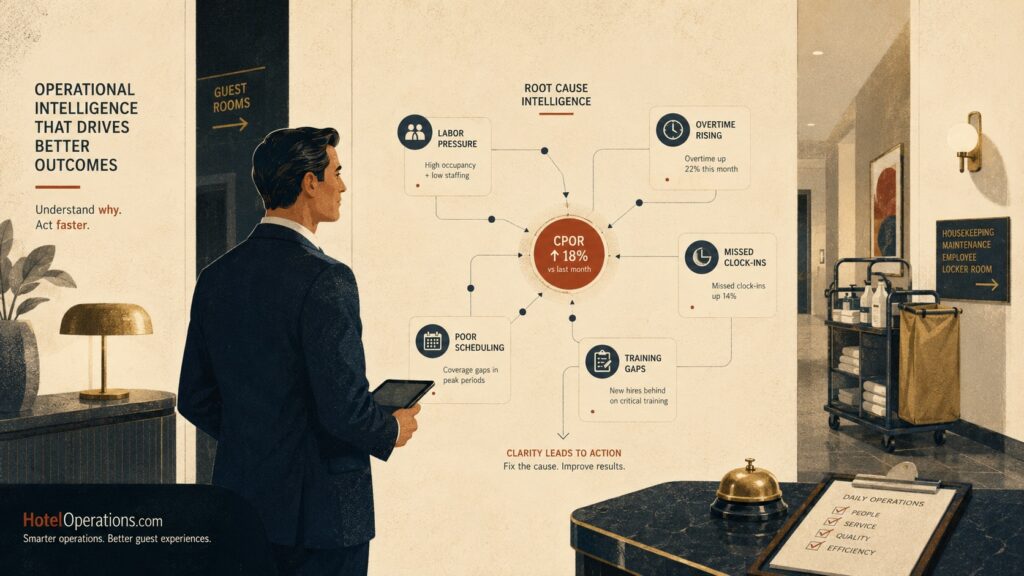
Once the data foundation is in place, the intelligence layer is “quite a bit easier,” Stephen said.
Every experienced operator has a decision tree in their head. When I see this data, I check that trend. I compare it to last year. I see this other component is also affected. I see if it’s a blip or a trend.
These are the things that run through your head automatically after years of doing the work.
AI can now do that pattern matching for you. “Not looking at the reports to find that and not having to go through the decision trees,” Stephen told me. “Getting the knowledge out of your head of what you check, what you look for, what is the underlying truth behind the data.”
He gave a specific example. A good intelligence layer isn’t telling you your cost per occupied room (CPOR) is growing. It’s telling you your CPOR is growing because of labor, because of overtime, because of clock-ins that aren’t being governed, because of poor schedules. It gets to the root cause, so you spend your time acting on the problem, not trying to figure out what the problem is.
Layer 3: Agentic AI

The third layer represents the frontier of where AI is heading.
“When you understand what needs to change and why it needs to change, and you have confidence, then you need to go to your system of action,” Stephen said of the current state of hotel technology. “Whether that’s your email or your budgeting and forecasting tool, your labor tool, whatever that is, when you find those insights and those things that you need to change, you still need to go into those locations and do it.”
Right now, insight and action are separated. You learn something in one system and then have to go execute it in another. What Stephen described as the next wave in AI is the ability to let agents do that work. “Not having to go and find the location, not having to log in and find this page, this schedule, this location, but actually being able to tell an agent, this is what I want to do, this is how I want to change it, and just having it done for you.”
His point about why this matters: “Insight without action is still ultimately meaningless. If you are getting a lot more insights, that is great, but if you can only act on so many of them, you still haven’t actually gotten the full value of it.”
What this looks like in practice: AI Asset Setup from Actabl
Frameworks are useful, but I get a little bored when AI conversations stay abstract. So I wanted to understand what this actually looks like when it hits the ground.
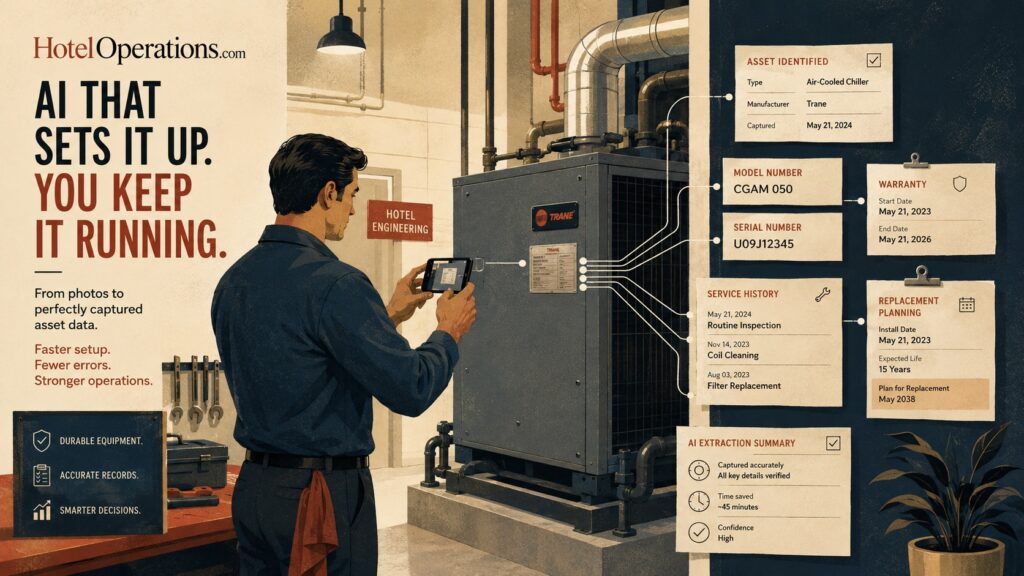
Jerimi Ford, Chief Innovation Officer at Actabl, walked me through a specific capability they recently released called AI Asset Setup within their Transcendent product. It’s a clear example of AI solving a real operational bottleneck.
Transcendent is a full asset management, capital budgeting, and CMMS system. It handles everything that makes a hotel operate behind the scenes: boilers, chillers, HVAC equipment, ice machines, fire life safety systems, elevators. As Jerimi put it, “Everything that makes your hotel operate that people don’t see, but without it, it wouldn’t operate.”
The problem was getting all of that into the system in the first place. Before AI Asset Setup, populating the database was either a manual process or required importing spreadsheets. And the manual process had a predictable failure point: someone would be transcribing 10, 15, 20-digit serial numbers from equipment nameplates, and at some point, they’d just decide that level of detail wasn’t important.
But as any hotel operator knows, this work is important. “We can leverage that serial number to go look at manufacturer information, figure out dates and service, warranty information,” Jerimi told me. “It turns into really mission-critical data.”
Now, an associate walks up to a piece of equipment, takes a photo from a distance (the system identifies what it is), then takes a close-up photo of the manufacturer plate. AI reads the manufacturer, model, serial number, and any other data on the plate. The whole process takes 15-30 seconds per asset.
Previously, it could take days, involve multiple people, and produce data riddled with errors.
That’s not a marginal improvement. It’s a different category of speed and accuracy. And the downstream benefits compound. With rich, accurate asset data, you get better capital budgets, more precise replacement planning, the ability to compare how your equipment performs against benchmarks, and eventually, purchasing power from understanding exactly what’s in your portfolio across every property.
Jerimi described the feedback loop this creates. “The system will be able to tell leadership both on property and above property, you need to take some action here because you are not performing at the level that your peers are. Maybe you’re missing PM cycles. Maybe someone’s not spending enough time. Your PMs are five minutes. There’s no way they PM’d the machine in five minutes. It should take 15 or 20 minutes.”
That’s intelligence built on a data foundation, pointing toward action. All three layers working together.
The human element still drives results

I asked Andrew about the limits of what AI can do in hotels.
“AI will enhance the capabilities, but it can’t take away the human element,” he told me. “There are absolutely going to be times when the manager on property has visibility into demand patterns that AI might not be bringing to light. It could be something about a weather event that just happened and is impacting something in your hotel tonight. That’s going to be difficult to interpret through AI.”
He’s right. Running a hotel is complicated, and things change fast. AI can identify patterns in historical data and surface recommendations, but the manager who sees a bus pull up with 40 unexpected guests, or who knows that a local employer just announced layoffs, or who feels the energy shift in a lobby, brings something that no model can replicate.
The frame Andrew offered was this: “AI can really supercharge our ability to have accurate forecasting on property and to identify demand patterns in advance and help the hotel team staff appropriately. There’s always going to be edge cases that will require the managers on property to make decisions based on their intuition and rely on their extensive experience.”
Getting people to actually use AI
One thing I’ve noticed at conferences is that everyone says they need AI. When I ask what they want to do with it, most people can’t answer that question.
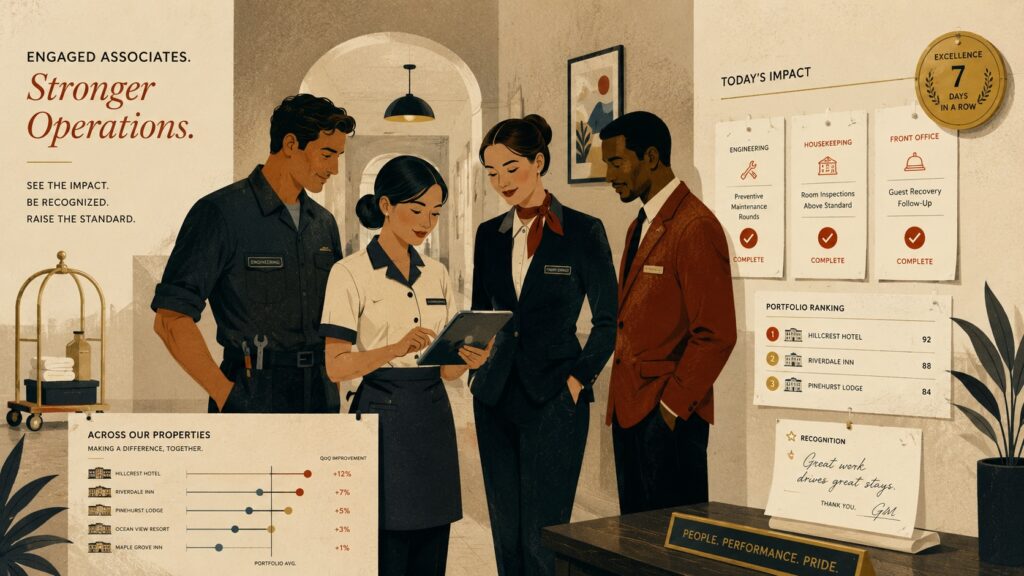
Jerimi shared something that I think is a model for getting adoption right. His team built a feature in Transcendent called Associate Engagement. It’s essentially gamification, but done thoughtfully.
Associates do their job. They get work assigned, they complete it, and then the system tells them how they’re doing. Did they complete tasks on time? Did they meet all the requirements? There are badges. There are leaderboards. Hotels compete against hotels within a portfolio.
“The amount of engagement that we had and the amount of change and actual cultural involvement, the excitement around it, was truly amazing,” Jerimi told me. He laughed about getting text messages at 1 AM from hotel engineers who noticed a process didn’t run at midnight and wanted to make sure their scores weren’t affected.
That’s not people tolerating technology. That’s people caring about the work because the technology made the work visible and meaningful.
What to do now with AI
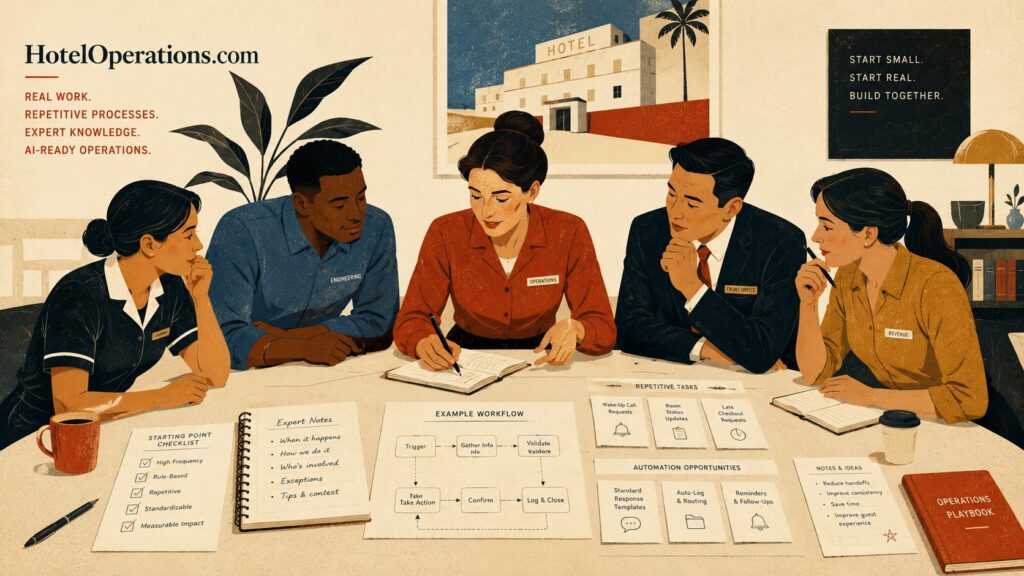
Stephen’s advice for getting started was practical. “Start by starting. That doesn’t mean you have to begin with the biggest, most complicated use case. Find the little things, find the things that are repetitive, that probably shouldn’t be repetitive. Ask yourself what are the things that you’re doing every day, and can those either be automated or made materially better with AI?”
Start by starting.
Stephen German, SVP Product, Actabl
He continued: “If you have people on your team who are experts at something, lean on them to document how they’re doing it. What are they doing with it? How can you approach that more programmatically? That’s where a lot of the magic shines because you get real results very quickly, and you also get your experts engaged as the folks who are going to drive the biggest, most material differences. That’s how you create your champions and your evangelists that then run with it.”
Andrew’s closing advice was direct and something every operations leader can learn from. “Be curious, have an open mind, embrace the power of data, and make sure you’re having the conversations. Those conversations could be on property with your coworkers. It could be in your daily standup meetings. It could be with your technology suppliers. Make sure that you are really challenging yourself to think differently and embrace this new superpower.”
The virtuous cycle
Stephen left me with one last idea that I keep coming back to. “The old investment adage is time in the market beats timing the market. And that is very true of AI as well.”
Time in the market beats timing the market. And that is very true of AI as well.
If you have your data foundation in place, if you’re getting intelligence signals, you can build on those, iterate, and add more context to make them more intelligent. The same is true with agents. The whole thing becomes a virtuous cycle that continues to build and improve.
The more you can do now, the sooner you do it, the more time you have to improve it, and the better it gets.
That’s not a pitch for moving fast and breaking things. It’s a case for starting. Getting your data house in order. Digitizing your workflows. Talking to your teams about where the friction lives. And then building from there, layer by layer.
The talent challenge isn’t going away. But with the right approach to AI, you don’t need every new hire to show up with 20 years of experience. You need them to show up ready to learn, with technology that meets them where they are and helps them perform like they’ve been doing it for years.
That’s the promise of AI in the hotel industry. And based on what I’m seeing, it’s starting to deliver.


