


“In this industry, we have struggled with siloed data and fragmentation. It’s really hard when you’re trying to understand the bigger picture of what’s happening, because you’re looking at too many sources of data.”
Monika Nerger, former Group Global CIO, Mandarin Oriental
“Data, data everywhere, but what the heck do I do with it?” – Clark Brayton, on the question every hotelier has been asking for years
Clark Brayton is a named inventor on a new U.S. patent for how Actabl normalizes data across hotel systems, the first of its kind in hotel technology.
I recently spoke with Clark and three others at Actabl responsible for this breakthrough: Joe McGroarty, who leads the data and analytics team at Actabl and runs a data lakehouse that moves tens of millions of rows a day; Pritesh Patel, director of product for integrations and a named inventor, who has spent the last decade bringing data from disparate hotel systems into a normalized layer; and Justin Call, chief legal officer and SVP of partnerships at Actabl and a named inventor, whose hospitality career runs through TravelClick (acquired by Amadeus) and Alice (acquired by Alpine, which became part of Actabl).
In this article, we cover:
Why hotel data fragmentation is so dangerous
I asked Joe what the challenge was with hotel data.
“There’s a lot of it, and it’s very disparate,” he said. “We’re talking about terabytes. At some point, it’s hard to fathom.” And then there’s the diversity of that data. “Hotel companies will do a lot of the labeling and tagging in a different way. To be able to bring all that data in is one real challenge.”
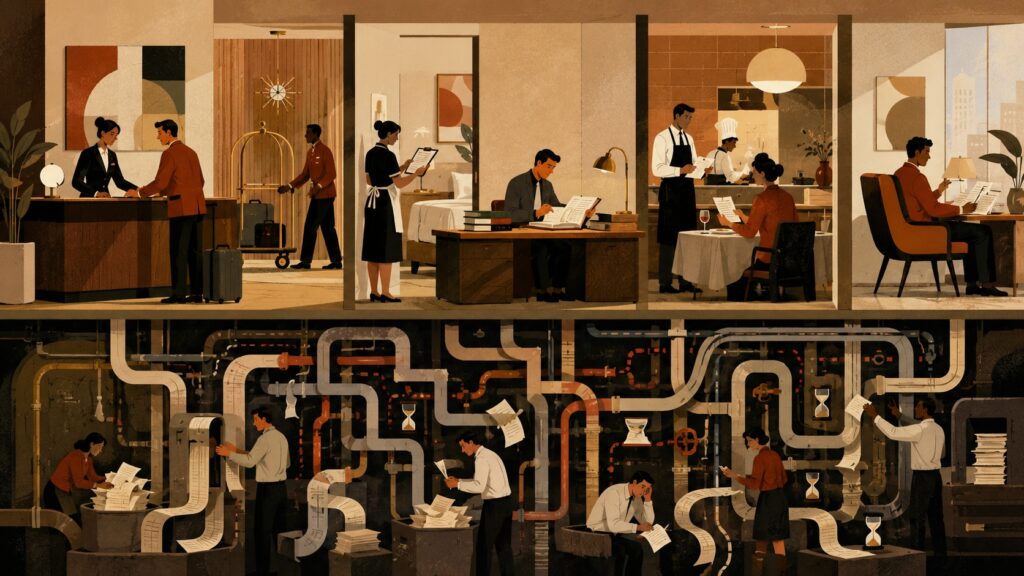
To say nothing of the number of sources and systems providing that data. A typical hotel runs ten to fifteen systems. Luxury, convention, and resort properties can run forty or more.
“Every system acts differently,” Pritesh told me. “Every system has a different way of communicating with other systems.”
Challenges multiply when you try to bring it together. Justin Call has seen this from building three different hotel data companies. He provided an example:
“You think a booking would be the same across all systems. It’s not.”
Justin Call, Chief Legal Officer and SVP of Partnerships, Actabl
“One system will call a booking one thing, another system will call it another thing,” Justin said. “One system will include taxes. The other system won’t include taxes. One will include extra services in the booking. It goes on and on and on. Just disentangling that across all the PMSs and central reservation systems, just for that one data element, is a hard job.”
Pritesh sees this pattern in every conversation with hoteliers.
“We have a ton of data. We want to do something with it. We need to find what that action is,” he said, describing what he hears from hotel leaders. “However, they don’t know what action to take without having the proper insights. And insights are backed by data. If you don’t have a way to normalize that data, you don’t have a way to look at everything in the same common language. That seems to be the biggest problem, at least from my conversations with many, many hotel operators, all the way from above property to on property.”
Ten years ago, the answer to all this might have been a person and a spreadsheet.
“Everything was just done manually via Excel,” Pritesh recalled. “Everything was rolled up via macros, just a normal person using their knowledge and bringing all the data together.”
Clark also saw this time and again. “It was time spent creating the roll-up reports that would then be emailed or faxed or, way back when, sometimes actually snail mailed to the corporate office,” he said. “And that was the hardest part, because you spent a lot of time looking backward. Does Joe have his report ready? Does Pritesh have his ready? As the GM or the corporate operator, I was always waiting on something.”
That time is not spent on guests, on coaching staff, or on the decisions that move the business forward. Decisions that had a lot of money on the line.
Building hotel data normalization at scale
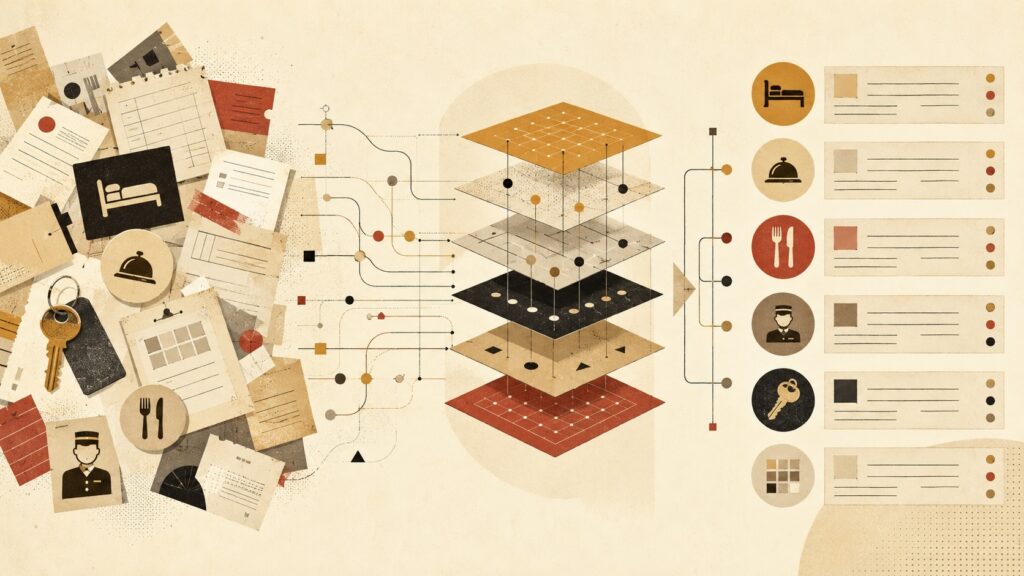
Justin offered a metaphor that helps us understand what’s at play here.
“When people see data products, they see the nice visualizations. That’s the tip of the iceberg. The bottom three-fourths of the iceberg is completely buried.”
Justin Call, Chief Legal Officer and SVP of Partnerships, Actabl
“All the work and the intellectual property to get to that visualization is what’s underwater,” Justin said. “So many people try to use Power BI and all these other tools, and they’re able to use it with limited success because that three-fourths of the iceberg isn’t understood. When they try to do something complex beyond simple financial modeling, they quickly realize that there are these three-quarters of the iceberg there.”
Joe described what is “under the waterline” for Actabl: progress based on more than a decade of compounding effort.
“We’ve been building up this data lakehouse that has this really great data in there,” he shared. “Because we’ve gone through it, we’ve learned our lessons.”
“It takes a lot of work. It’s not easy. It takes time.”
Joe McGroarty, Head of Data and Analytics, Actabl
Scale is part of why. Excel tops out around 1.4 million rows, and anyone who has used it for reporting knows it slows well before that. Actabl moves tens of millions of rows every day. The company supports more than 400 active integrations across property management systems, point-of-sale systems, accounting systems, labor systems, and OTA data feeds.
The other part is the large, complex network of hotel technology providers, each with software that tracks data elements differently. Justin spoke to the scale of what Actabl has had to disambiguate.
“The team didn’t just solve normalization for one data element,” he said. “They solved it for every element. Thousands of data elements. To figure that out and resolve those issues in real time is insane.”
The approach that made it possible is the opposite of how other data companies have operated.
“At other hotel tech companies, it dealt only with data that had been specified,” Justin said. “You went to the customer and said, ‘You’ve got to deliver the data, it has to look exactly like this.’ The Actabl team took the opposite approach. They said, just give us your data, and we’ll figure it out.”
Pritesh shared what that looks like practically:
“We tell every vendor the same thing,” he said. “Show us what you have and how you can provide it, and we will make it work. It does not matter how the data comes in. What matters is that when it lands in Actabl, it means the same thing it means everywhere else.”
How Actabl’s hotel data normalization works
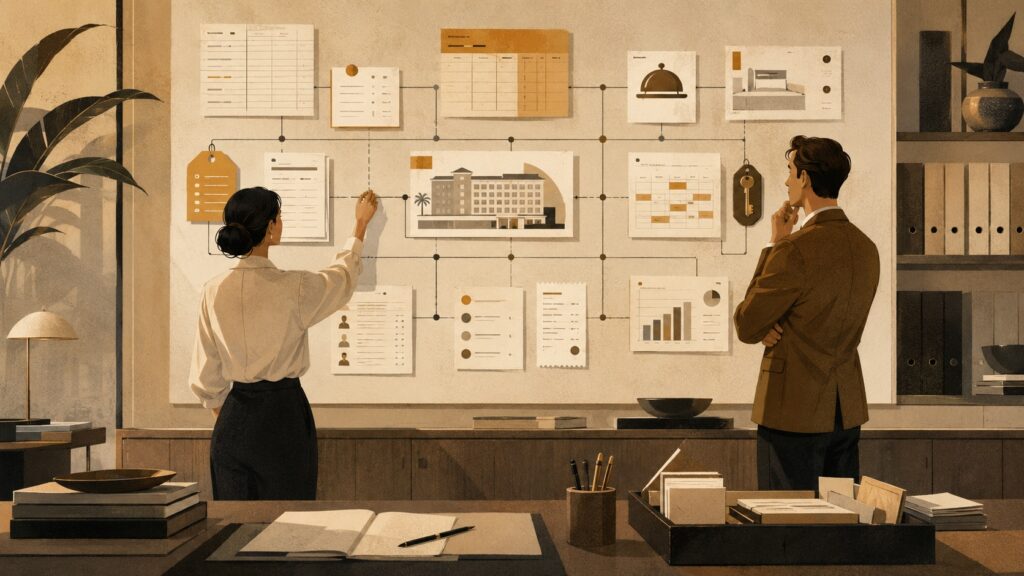
I asked the team to walk through the process in terms that anyone could understand.
Clark started with the basics. “Each hotel has a PMS system. Think of a brand. You go to the front desk, check in at a Hilton or a Marriott, and they use a proprietary system that contains your guest information. You go through the check-in process and eventually the check-out process. All that information is needed to operate a hotel effectively on a daily and monthly basis.”
But it doesn’t stop there.
“Once you have all that information, how do you put it together at scale?” Clark continued. “That’s where the normalization comes in, because each brand is proprietary. We take all those disparate sources and normalize them, translate them to the management company’s master account system. So it’s immediate visibility as soon as we receive the data.”
Pritesh then got into the technical details of what’s at play.
“There are different vendors, there are different partners, and the way they structure their data, everything is just different. None of them speaks the same language,” he said. “Accounting system, reservation system, revenue management systems, OTAs. So many systems, all producing data in different formats, different naming conventions, and often meaning different things, or different meanings for the same thing.”
Other previous attempts at hotel data standardization tried to force every property into a rigid format, such as USALI or the chart of accounts. Actabl took a different path.
“We’re using a tag-based approach,” Pritesh explained. “This is a little bit different from the chart of accounts or the USALI format. That is a rigid format in the accounting standards. But when it comes to data, there’s standard data, structured data, unstructured data, and data tied to KPIs like your occupancy. We’re bringing all of that into a normalized, tag-based layer.”
Every piece of data that enters Actabl gets a tag that tells the system what it means, regardless of which system it came from. When an operator asks a question, the system answers from the tags.
“What is my revenue? Well, that’s not just one number. That’s a stitch of multiple data points from different systems.”
Pritesh Patel, Director of Product for Integrations, Actabl
“Reconciling all of that, figuring out what needs to roll up to that definition of revenue. That’s the problem we’ve solved for,” Pritesh added. “We’re brand-agnostic. We bring in independent hotels, all the major brands, and all that data comes in. As an owner or operator, when you’re asking the question, what is my revenue, you’re looking at a P&L, you’re looking at your various reporting, and all of that syncs up to that same language.”
Why hotel data normalization matters more in an AI world
Every hotel operator today is being asked the same question by their owners and their boards: What is your AI strategy?
The honest answer starts with the inputs. The data. But as we’ve reviewed, the challenges so many face make this harder than it looks.
Justin named something specific that you may have experimented with.
“The practice of just dumping CSV files into AI tools can provide interesting answers. But the key to making that scalable is based on how good your data is and how well organized.”
Justin Call, Chief Legal Officer and SVP of Partnerships, Actabl
“The key term here is normalized,” Justin said. “Does the AI system actually understand what the data means, consistently, at scale? You need to think about your data in a way that you’ve never had to before. In order to truly unlock the potential of AI, you have to have the ability to annotate and normalize your data at scale.”
Joe described what happens when you do not.
“You can’t just throw a bunch of random data into an AI and ask questions and expect a good answer,” he said. “You can get an answer, and people might even make decisions based on those answers. But if you don’t have the data normalized, if it’s not sitting in one place that you can ask questions of, then you’re going to get a lot of hallucinations inside of the AI answers.”
“You can’t just throw a bunch of random data into an AI and ask questions and expect a good answer.”
Joe McGroarty, Head of Data and Analytics, Actabl
Joe went on to explain what makes the difference between a confident answer and a useful one.
“Context matters so much with AI, and being able to have this data normalized gives us a focus point to be able to put a lot of context on top of it,” he said. “What does revenue mean? What other types of drivers are there for profitability? Those types of things we can start defining better because we’re working with one tag instead of working with a hundred tags from a hundred different sources.”
Our own research on where hotel technology helps and where it still falls short points to something operators consistently tell me: The tools are only as good as the data underneath them.
“Are you ready for the next frontier of hospitality? Is your hotel structured in a successful way in terms of your systems and your tech stack to unlock the next frontier: Powering hospitality through AI?”
Pritesh Patel, Director of Product Integrations, Actabl

Questions to ask about your hotel data
I asked Clark, Joe, and Pritesh for some questions you can bring into your work today. Here’s what they said:
Clark: How much time is your team spending monitoring systems that could be normalized automatically? How much time is your team spending gathering and assembling reports?
Joe: Where does your data live? Who are the people responsible for getting it ready? What does your process look like for cleaning, standardizing, and normalizing it?
Pritesh: How many systems are you running today, and do they actually talk to each other? Are you collecting data in a way that lets you do something meaningful with it?
Frequently asked questions
What is hotel data normalization?
Hotel data normalization is the process of translating data from different hotel systems, including property management, accounting, revenue management, OTAs, and others, into a common language that allows for consistent reporting and analysis. Without it, the same metric like total revenue can mean something different depending on which system you pull it from.
Why does data normalization matter for AI in hotels?
AI tools produce answers based on the data they are given. If that data is inconsistent or spread across systems that do not agree with each other, AI responses will reflect those inconsistencies, sometimes producing confident-sounding wrong answers. Normalized data gives AI a single reliable foundation to work from.
What is a tag-based approach to hotel data?
Rather than forcing every hotel’s data into a rigid standard format like USALI, a tag-based approach assigns descriptive tags to each data point as it enters the system. This allows data from different hotel systems and brands to be interpreted consistently without requiring each source to share the same structure.
How many systems does a typical hotel need to integrate?
A limited-service hotel typically runs ten to fifteen systems. Luxury hotels, convention properties, and resorts can run forty or more. Across a portfolio of fifty to a hundred hotels, the data complexity multiplies significantly.
What does Actabl’s data patent cover?
Actabl received a U.S. patent for its method of normalizing hotel data across disparate systems using a tag-based approach. It is the first hotel technology company to receive a patent specifically for this method. Full details are available at actabl.com.
This piece draws from a conversation with Joe McGroarty, Clark Brayton, and Pritesh Patel. Listen to the full discussion on the Hospitality Daily Podcast.


